이 글은 Ashish Vaswani 외, Attention Is All You Need (NeurIPS 2017)를 읽고 정리한 요약이다. 본문의 그림과 표는 원 논문에서 가져왔고, 인용한 자리마다 출처를 적었다.
Background
Transformer 이전에도 Extended Neural GPU, ByteNet, ConvS2S 같은 구조들이 CNN을 기반으로 순차적 계산 과정을 줄이기 위해 등장했지만, 이 구조들은 입력과 출력 요소의 위치가 멀어질수록 필요한 계산량이 늘어나 먼 요소들 사이의 관계를 학습하기 어렵다는 한계가 있었다.
Self-attention은 한 시퀀스 내의 여러 위치 사이의 관계를 통해 그 시퀀스의 representation을 만드는 기법이다.
Transformer는 기존 구조들과 다르게 순서 기반인 RNN이나 convolution을 아예 사용하지 않고 attention만을 사용한 최초의 구조로, 이를 통해 많은 이득을 얻었다.
Model Architecture
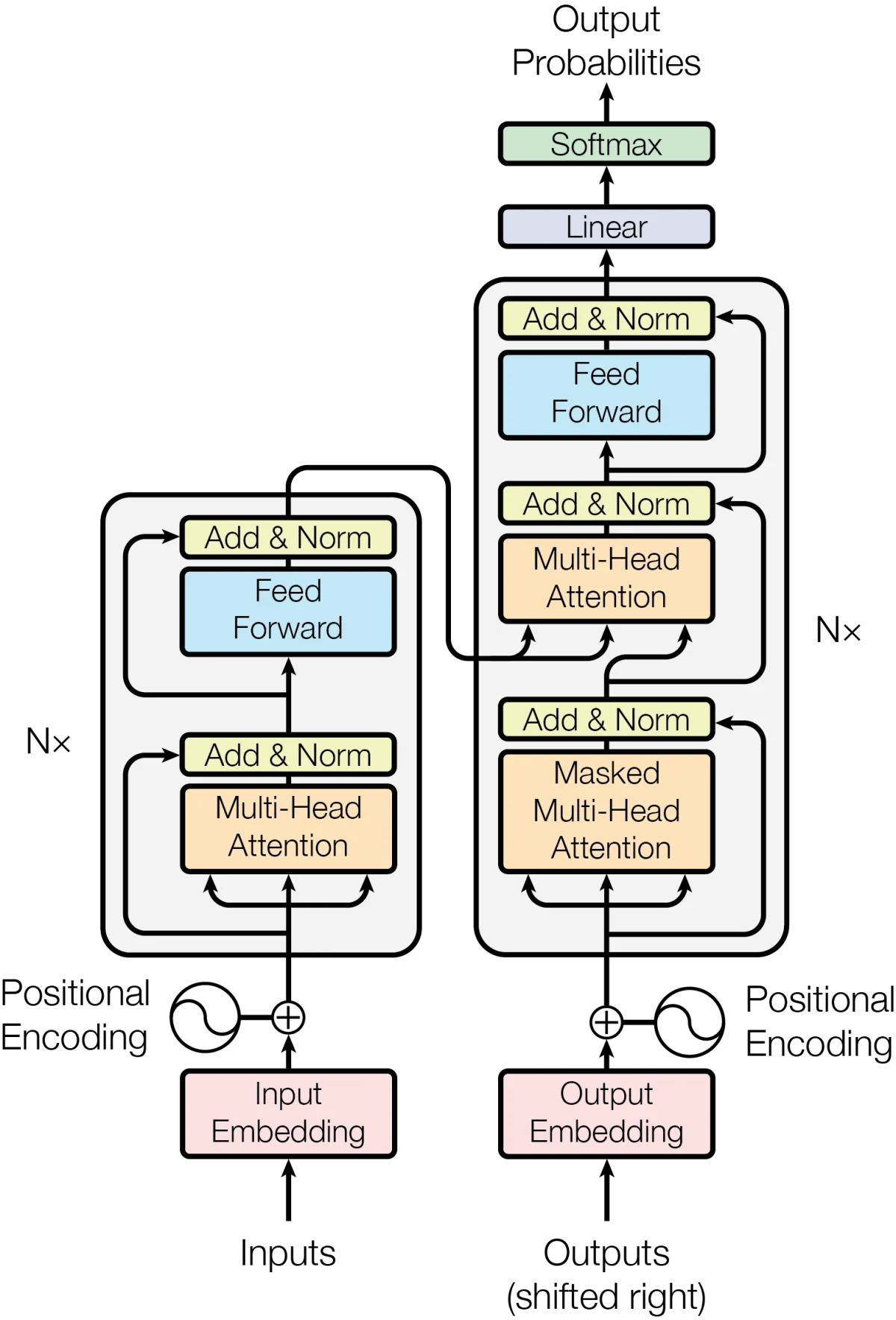
Transformer는 N개의 인코더와 N개의 디코더로 구성되어 있다. 인코더에 input을, 디코더에 output을 임베딩해서 입력하고, 둘 다 Positional Encoding을 더해서 인코더와 디코더에 들어간다.
Encoder
- Multi-Head Self-Attention
- Residual + Normalization
- Feed Forward(완전 연결망)
- Residual + Normalization
으로 한 개의 Encoder가 구성되어 있다.
Decoder
- Masked Multi-Head Attention
- 미래를 보지 않고 예측하기 위해, $i$번째 단어에서는 $i$번까지의 단어끼리의 attention만 계산하는 attention
- Residual + Normalization
- Multi-Head Attention
- Encoder의 output과 이전 레이어에서 받은 결과로 attention
- Residual + Normalization
- Feed Forward(완전 연결망)
- Residual + Normalization
로 한 개의 Decoder가 구성되어 있다. 그리고 마지막에 Linear 층과 Softmax를 통과해서 확률의 형태로 최종 output을 생성한다.
Attention
Attention은 Q(쿼리), K(키), V(밸류)를 입력으로 받아서 V의 weighted sum vector를 output으로 생성하는 것으로, 이때 weight는 Q와 K의 유사도를 통해 구해진다.
$$\text{Attention}(Q, K, V) = \text{softmax}\left(\frac{QK^{T}}{\sqrt{d_k}}\right)V$$
$\frac{1}{\sqrt{d_k}}$는 $QK^{T}$의 디멘션이 커질수록 attention의 성능이 낮아지는 현상을 막기 위해 추가되었다.
비유를 통한 이해
- Q는 질문
- K는 사전의 인덱스
- V는 인덱스에 해당하는 실제 값
질문에 해당하는 사전 항목을 찾고($QK^{T}$), 실제 그 항목의 내용을 더한다($\text{softmax}(\cdot)V$).
Multi-Head Attention
Multi-Head Attention은 Q, K, V에 Head마다 다른 $W$를 곱한 후에 Attention을 계산하고, 마지막에 모든 Head의 output을 concat한 다음 $W^{O}$를 곱해서 정보를 다시 섞는 과정을 거치는 attention이다.
Feed Forward Networks
$$\text{FFN}(x) = \max(0,\; xW_1 + b_1)W_2 + b_2$$
Positional Encoding
- Transformer는 RNN/CNN처럼 순서 정보를 구조적으로 가지지 않기 때문에, 토큰의 위치 정보를 embedding에 추가한다.
- 각 위치 $pos$마다 $d_{model}$차원의 positional encoding 벡터를 만든다.
- $i = 0$부터 $d_{model}/2 - 1$까지 증가시키며 아래를 계산한다.
$$PE(pos,\, 2i) = \sin\left(\frac{pos}{10000^{2i/d_{model}}}\right), \qquad PE(pos,\, 2i+1) = \cos\left(\frac{pos}{10000^{2i/d_{model}}}\right)$$
- 각 $i$마다 sin, cos 값 2개를 만들기 때문에 총 $d_{model}$차원이 된다.
- 차원마다 서로 다른 주기를 사용하여 각 위치를 서로 구별하기 쉽게 하고, 가까운 거리부터 먼 거리까지 다양한 위치 관계를 표현한다.
- 만들어진 positional encoding은 token embedding에 더한다.
$$X_{input} = Embedding + PositionalEncoding$$
- sin/cos를 사용하면 $pos+k$의 위치 정보를 $pos$의 위치 정보로부터 선형적으로 표현할 수 있어 상대적 위치 관계도 학습하기 쉽다.
Self-Attention
동일 길이의 시퀀스를 다른 동일 길이의 시퀀스로 변환하는 방법들 중 RNN, CNN에 비해 Self-Attention이 갖는 주요한 장점은 아래와 같다.
- 병렬화가 쉽다 — 순서대로 연산할 필요가 없기 때문에 self-attention은 병렬화로 더 빠른 계산이 가능하다.
- 멀리 떨어진 토큰의 관계를 쉽게 학습한다 — maximum path length가 $O(1)$이기 때문에 거리가 먼 토큰과의 관계를 쉽게 학습할 수 있다.
- 일반적인 문장 길이에서 계산량도 유리하다 — 보통 $n < d$이기 때문에 계산 복잡도가 $O(n^2 \cdot d)$인 self-attention이 다른 방법보다 유리하다.
| Layer Type | Complexity per Layer | Sequential Operations | Maximum Path Length |
|---|---|---|---|
| Self-Attention | $O(n^2 \cdot d)$ | $O(1)$ | $O(1)$ |
| Recurrent | $O(n \cdot d^2)$ | $O(n)$ | $O(n)$ |
| Convolutional | $O(k \cdot n \cdot d^2)$ | $O(1)$ | $O(\log_k n)$ |
| Self-Attention (restricted) | $O(r \cdot n \cdot d)$ | $O(1)$ | $O(n/r)$ |
원 논문 Table 1(Vaswani et al., 2017)을 옮긴 것이다. $n$은 시퀀스 길이, $d$는 representation 차원, $k$는 convolution의 커널 크기, $r$은 restricted self-attention의 이웃 크기다.
추가로, 결과 해석도 self-attention이 더 용이하다.
참고
- Ashish Vaswani, Noam Shazeer, Niki Parmar, Jakob Uszkoreit, Llion Jones, Aidan N. Gomez, Łukasz Kaiser, Illia Polosukhin, Attention Is All You Need, Advances in Neural Information Processing Systems 30 (NeurIPS 2017), pp. 5998–6008. arXiv:1706.03762 — 이 글이 요약한 원 논문이다. 본문의 구조도는 이 논문의 Figure 1, 복잡도 비교표는 Table 1이다. PDF